Openfire4.9.2
Openfire is a real time collaboration (RTC) server licensed under the Open Source Apache License. It uses the only widely adopted open protocol for instant messaging, XMPP Openfire is incredibly easy to setup and administer, but offers rock-solid security and performance.


I get regular requests and issues have been raised about upgrading the Jitsi meet code in the Openfire Pade plugin to the latest versions. Unfortunately, this task is much more difficult than it sounds.
Jitsi Meet has evolved a lot since the early days of WebRTC. It has moved from being a Java platform agnostic, XMPP compatible self-hosting application into a Linux cloud hosted service.
The current code still depends on our Smack project for the XMPP client, but it uses Prosody as the XMPP server with quite a few extensions and modules coded in Lua which need to be ported to Java. Apart from not having time to work on it, I have also lost the motivation to step up to the challenge as I am more interested in using WHIP and WHEP with XMPP.
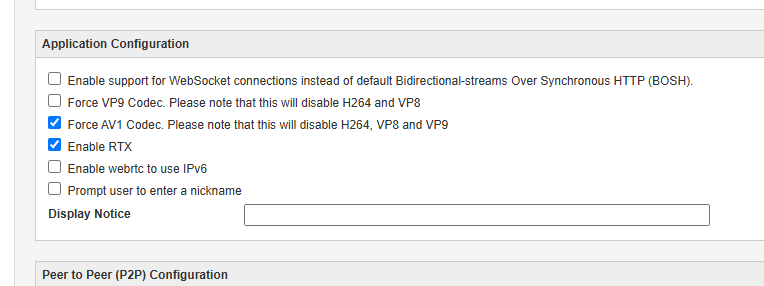
Nevertheless, an issue can round last week requesting for support of AV1 codec. This sparked enough motivation for me to spend my Easter holidays trying one more time to make the upgrade happen. The bad news is that I failed yet again, but the good news is that I was able to update the existing code to support AV1. Please note that codecs have pros and cons. VP9 is probably the best all rounder. H264 is best with devices that have hardware encoders and AV1 handles low bandwidth the best.
Openfire Pade plugin version 1.8.4 now supports the AV1 codec. You get the best results with P2P calls. As it is it more CPU intensive than VP9, you make get lower frame rates on low-spec servers. The latest Jitsi code has a lot more improvements and if you really need AV1 with many participants, seriously consider deploying the Jitsi Meet self-hosted instance in a container or VM.
As always, your instance of Openfire should automatically make available to update. Alternatively, you can download the new release of the plugin at the Openfire Pade plugin’s archive page.
For other release announcements and news follow us on Mastodon or X

Today, we’ve released a new version of the Threaddump plugin for Openfire: version 1.2.0.
The Threaddump plugin is a handy plugin to collect diagnostics, useful for drilling down into the inner workings of Openfire. It can be of great value for developers, but is of little use to others.
In this new release, compatibility with Openfire versions 4.8.0 and later has been restored! To do so, some functionality was sacrificed: the plugin will no longer offer the possibility to automatically generate thread dumps when core thread pools reach a certain level of activity.
As always, your instance of Openfire should automatically make available to update in the next few hours. Alternatively, you can download the new release of the plugin at the Threaddump plugin’s archive page.
For other release announcements and news follow us on Mastodon or X
The Ignite Realtime community is happy to be able to announce the immediate availability of version 4.9.1 of Openfire, its cross-platform real-time collaboration server based on the XMPP protocol!
4.9.1 is a bugfix and maintenance release. Among its most important fixes is one for a memory leak that affected all recent versions of Openfire (but was likely noticeable only on those servers that see high volume of users logging in and out). The complete list of changes that have gone into this release can be seen in the change log.
Please give this version a try! You can download installers of Openfire here. Our documentation contains an upgrade guide that helps you update from an older version.
The integrity of these artifacts can be checked with the following sha256sum values:
8c489503f24e35003e2930873037950a4a08bc276be1338b6a0928db0f0eb37d  openfire-4.9.1-1.noarch.rpm
1e80a119c4e1d0b57d79aa83cbdbccf138a1dc8a4086ac10ae851dec4f78742d  openfire_4.9.1_all.deb
69a946dacd5e4f515aa4d935c05978b5a60279119379bcfe0df477023e7a6f05  openfire_4_9_1.dmg
c4d7b15ab6814086ce5e8a1d6b243a442b8743a21282a1a4c5b7d615f9e52638  openfire_4_9_1.exe
d9f0dd50600ee726802bba8bc8415bf9f0f427be54933e6c987cef7cca012bb4  openfire_4_9_1.tar.gz
de45aaf1ad01235f2b812db5127af7d3dc4bc63984a9e4852f1f3d5332df7659  openfire_4_9_1_x64.exe
89b61cbdab265981fad4ab4562066222a2c3a9a68f83b6597ab2cb5609b2b1d7  openfire_4_9_1.zip
We would love to hear from you! If you have any questions, please stop by our community forum or our live groupchat. We are always looking for volunteers interested in helping out with Openfire development!
For other release announcements and news follow us on Mastodon or X
The Ignite Realtime community is happy to be able to announce the immediate availability of version 4.9.0 of Openfire, its cross-platform real-time collaboration server based on the XMPP protocol!
As compared to the previous non-patch release, this one is a bit smaller. This mostly is a maintenance release, and includes some preparations (deprecations, mainly) for a future release.
Highlights for this release:
- A problem has been fixed that caused, under certain conditions, a client connection to be disconnected. This appears to have affected clients sending multi-byte character data more than others.
- Community member Akbar Azimifar has provided a full Persian translation for Openfire!
The list of changes that have gone into the Openfire 4.9.0 release has some more items though! Please review the change log for all of the details.
Interested in getting started? You can download installers of Openfire here. Our documentation contains an upgrade guide that helps you update from an older version.
The integrity of these artifacts can be checked with the following sha256sum values:
7973cc2faef01cb2f03d3f2ec59aff9b2001d16b2755b4cc0da48cc92b74d18a  openfire-4.9.0-1.noarch.rpm
a0cd627c629b00bb65b6080e06b8d13376ec0a4170fd27e863af0573e3b4f791  openfire_4.9.0_all.deb
bf62c02b0efe1d37fc505f6942a9cf058975746453d6d0218007b75b908a5c3c  openfire_4_9_0.dmg
1082d9864df897befa47230c251d91ec0780930900b2ab2768aaabd96d7b5dd9  openfire_4_9_0.exe
12a4a5e5794ecb64a7da718646208390d0eb593c02a33a630f968eec6e5a93a0  openfire_4_9_0.tar.gz
c86bdb1c6afd4e2e013c4909a980cbac088fc51401db6e9792d43e532963df72  openfire_4_9_0_x64.exe
97efe5bfe8a7ab3ea73a01391af436096a040d202f3d06f599bc4af1cd7bccf0  openfire_4_9_0.zip
We would love to hear from you! If you have any questions, please stop by our community forum or our live groupchat. We are always looking for volunteers interested in helping out with Openfire development!
For other release announcements and news follow us on Mastodon or X
We have now released version 1.4.1 of the HTTP File Upload plugin!
This plugin adds functionality to Openfire that allows clients to share files, as defined in the XEP-0363 ‘HTTP File Upload’ specification.
This release brings two changes, both provided by community members (thanks!):
- Vladislav updated the Ukrainian translation;
- Anno created an admin console page for this plugin.
As always, your instance of Openfire should automatically make available to update in the next few hours. Alternatively, you can download the new release of the plugin at the HTTP File Upload plugin’s archive page.
For other release announcements and news follow us on Mastodon or X

 softwaringengineer in "
 Cube in "
 Jeff29 in "
 Daniel in "